












In the field of industrial water treatment, a phenomenon frequently perplexes plant operators and engineers: the feed water supply is chemically neutral (pH ≈ 7.0), yet the Reverse Osmosis permeate pH consistently drops to acidic levels, often ranging between 5.0 and 6.0. Conversely, in specific applications such as wastewater reuse or landfill leachate treatment, the permeate pH can spike unexpectedly, exceeding the pH of the inlet water.
This fluctuation is rarely due to membrane failure or equipment malfunction. Instead, it is a predictable chemical outcome governed by the laws of thermodynamics and membrane selectivity. The Reverse Osmosis (RO) process fundamentally alters the chemical equilibrium of the water by separating dissolved ions while allowing gases to pass freely.
Understanding the underlying mechanisms of Reverse Osmosis permeate pH fluctuation is not merely an academic exercise; it is critical for protecting downstream equipment from corrosion, ensuring compliance with environmental discharge standards, and designing effective post-treatment polishing systems.
The Mechanism of pH Drop: The Carbon Dioxide Equilibrium
The vast majority of standard brackish water and tap water RO systems experience a distinct drop in product water pH. To understand this, we must analyze the Carbonate Buffering System, which dictates the pH of most natural water sources.

1. The Chemical Balance in Feed Water
In natural water, Carbon Dioxide ($CO_2$), Bicarbonate ($HCO_3^-$), and Carbonate ($CO_3^{2-}$) exist in a dynamic equilibrium. The simplified equation for this relationship is:
CO2 + H2O ⇌ HCO3– + H+
This equation indicates that Carbon Dioxide reacts with water to form Bicarbonate and Hydrogen ions (acid). In a stable feed water stream, this system is balanced.
2. Selective Membrane Separation
The defining characteristic of a Reverse Osmosis membrane is its ability to reject dissolved solids based on size and ionic charge. According to standard filtration principles, RO membranes typically achieve a rejection rate of 99% or higher for charged ions such as Bicarbonate ($HCO_3^-$).
However, gases behave differently. Carbon Dioxide ($CO_2$) is a small, non-polar, and uncharged molecule (Molecular Weight ≈ 44 g/mol). RO membranes do not screen out dissolved gases effectively. Consequently, while the alkalinity (Bicarbonate) is stripped away and concentrated in the brine stream, the Carbon Dioxide passes freely into the permeate stream.

For further reading on gas solubility and membrane properties, authoritative resources such as the USGS Water Science School provide fundamental data on water chemistry properties.
3. The Equilibrium Shift (Le Chatelier’s Principle)
Once the water passes through the membrane, the chemical environment changes drastically. The permeate side now contains a high concentration of dissolved $CO_2$ but is virtually devoid of $HCO_3^-$.
Experimental data shows that even if the feed water contains 100 mg/L of Bicarbonate, the permeate may contain less than 1 mg/L. To restore equilibrium in this new environment, the $CO_2$ reacts with water molecules, shifting the reaction equation to the right. This generates new traces of Bicarbonate and, crucially, releases free Hydrogen ions ($H^+$).
Since pH is the negative logarithm of the Hydrogen ion concentration, this release of $H^+$ causes the Reverse Osmosis permeate pH to drop sharply, making the water aggressive and corrosive to carbon steel piping.
4. The Impact of Operating Pressure
Another contributing factor is Henry’s Law, which states that the solubility of a gas in a liquid is directly proportional to the partial pressure of that gas above the liquid. RO systems operate at high pressures (often 10–60 bar). This pressure forces more $CO_2$ to remain dissolved in the water.
When the permeate exits the pressure vessel and returns to atmospheric pressure, the equilibrium is further disturbed, often resulting in unstable pH readings until the gas off-gasses or stabilizes.
The Mechanism of pH Rise: The Ammonia Transport Anomaly
While pH drops are common in tap water applications, a rise in Reverse Osmosis permeate pH is frequently observed in industrial wastewater treatment, landfill leachate processing, and condensate polishing. This phenomenon is almost exclusively linked to the presence of Ammonia Nitrogen.
1. Ammonium vs. Ammonia
Nitrogen exists in water primarily in two forms, depending on the pH: Ammonium ion ($NH_4^+$) and Ammonia gas ($NH_3$). The equilibrium equation is:
NH3 + H2O ⇌ NH4+ + OH–
2. The Transport Mechanism
Similar to the Carbon Dioxide scenario, the RO membrane discriminates based on charge:
- Ammonium ($NH_4^+$): Being a charged cation, it is rejected by the membrane with high efficiency.
- Ammonia ($NH_3$): Being a neutral gas with a low molecular weight (17 g/mol), it permeates through the membrane pores easily.
As the RO process concentrates the feed water, the concentration of ions increases on the brine side. This accumulation can force the chemical equilibrium to shift, converting more Ammonium into Ammonia gas, which then crosses the membrane barrier.
3. Re-Equilibration and pH Spike
Once the gaseous $NH_3$ enters the dilute permeate stream, it seeks to re-establish equilibrium by reacting with water molecules. It acquires a Hydrogen ion from the water to revert to Ammonium ($NH_4^+$). This reaction leaves behind a surplus of Hydroxide ions ($OH^-$).
An increase in Hydroxide ions equates to an increase in alkalinity, causing the Reverse Osmosis permeate pH to rise above that of the feed water.
4. The Critical Role of Feed pH
The ratio of $NH_3$ to $NH_4^+$ is governed by the solution’s pH and dissociation constant ($pK_a \approx 9.25$).
- At pH 7.0: Ammonia gas constitutes only about 0.6% of the total nitrogen species. The membrane rejection rate remains high (typically >90%).
- At pH 10.0: Ammonia gas constitutes approximately 64% of the total nitrogen. The rejection rate plummets to below 30% as the gas passes freely through the membrane.
This explains why high-pH industrial wastewater feeds are particularly prone to ammonia breakthrough and subsequent permeate pH spikes.
Engineering Solutions for pH Control
Understanding these mechanisms allows plant owners to implement robust mitigation strategies. Ignoring pH fluctuation can lead to rapid corrosion of distribution piping and non-compliance with local discharge regulations.
1. Post-Treatment pH Adjustment
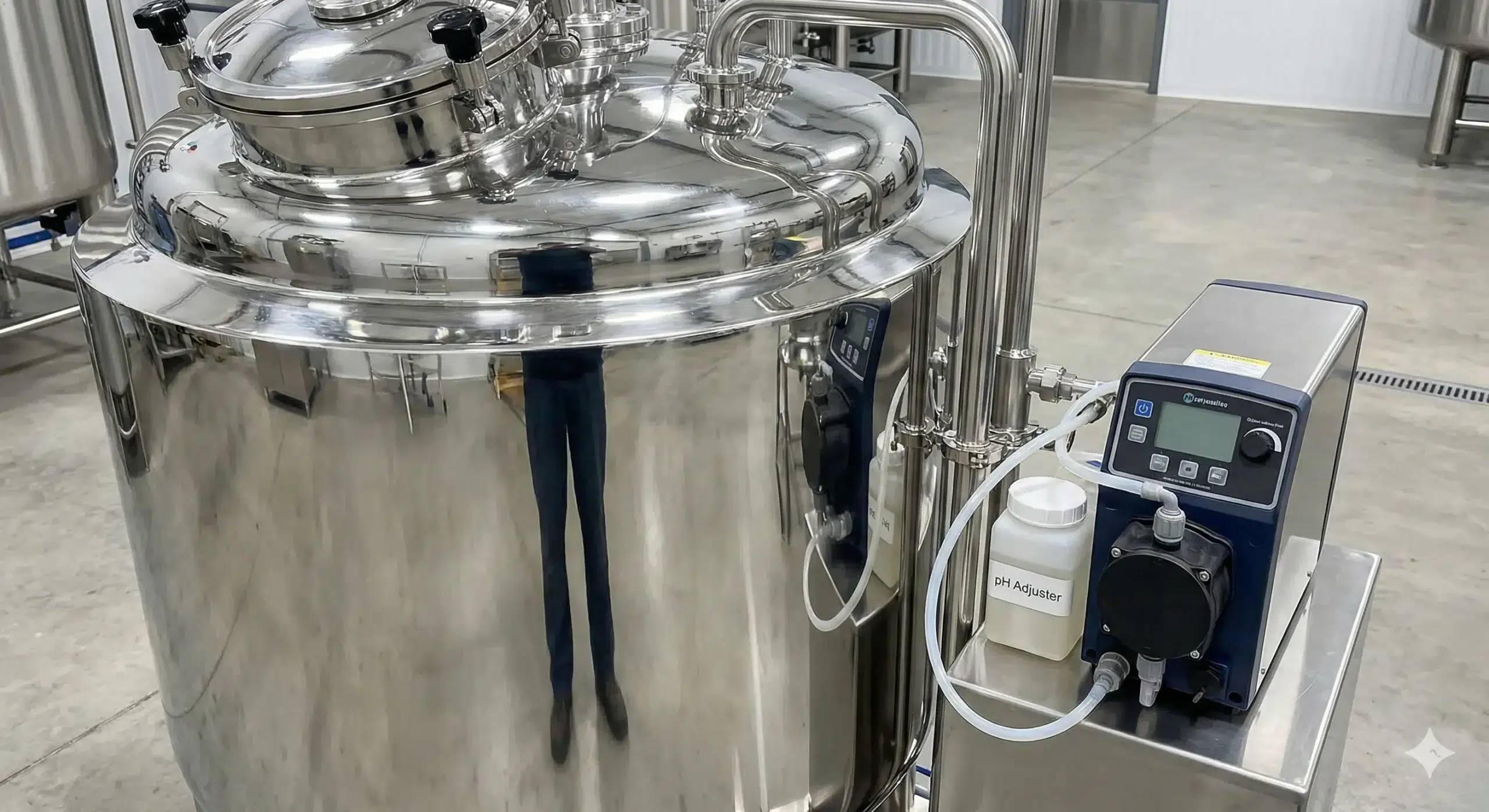
For acidic permeate caused by $CO_2$, the most common solution is the installation of a chemical dosing system. By injecting Sodium Hydroxide (NaOH) or passing the water through a calcite filter, the pH can be neutralized.
This process requires precise mixing and reaction time. We recommend utilizing sanitary-grade vessels for this application to prevent re-contamination. For detailed specifications on suitable mixing vessels, you can refer to our Stark Stainless Steel Mixing Tanks, which are designed for chemical dosing integration.
2. Decarbonation Towers
If the $CO_2$ concentration is exceptionally high, chemical dosing may become cost-prohibitive. In these instances, a forced-draft degasifier or decarbonation tower is installed post-RO to physically strip the Carbon Dioxide gas from the water before it enters the storage tank.
3. Corrosion-Resistant Storage
For systems dealing with fluctuating pH levels—especially in wastewater reuse where ammonia may cause spikes or variable chemistry—storage tanks must be chemically inert. Standard carbon steel or low-grade plastics may degrade over time.
For these aggressive applications, high-strength composite materials are the industry standard. Our Stark Fiberglass (FRP) Tanks utilize filament winding technology to provide superior resistance to both acidic and alkaline environments, ensuring long-term asset protection.
A Note on Measuring pH in RO Permeate
It is important to note that measuring the Reverse Osmosis permeate pH can be technically challenging. RO permeate is low in ionic strength (low conductivity). Standard pH probes rely on ionic conductivity to complete the measurement circuit.
In high-purity water, standard probes often drift, provide unstable readings, or respond slowly. Engineers should ensure they are using pH sensors specifically calibrated for low-ionic-strength water to avoid false alarms regarding system performance.
Заключение
The fluctuation of pH in Reverse Osmosis permeate is a natural consequence of the membrane’s selective filtration properties. It is driven by the dynamic equilibrium of Carbon Dioxide in fresh water and Ammonia in wastewater.
By quantifying these shifts, engineers can design appropriate pre-treatment and post-treatment stages. Whether through degassing, chemical dosing, or selecting the correct storage materials, managing these chemical changes is essential for the longevity of your water treatment plant.
Optimize Your System Design Today
Does your facility struggle with unstable water quality? Contact Stark Water’s engineering team. We provide comprehensive system analysis and manufacture the high-performance storage and mixing vessels required to stabilize your process.