












The conductivity problem of reverse osmosis equipment purified water equipment is a problem often encountered by many purified water equipment manufacturers. In response to this situation, STARK Water Treatment summarizes the causes and solutions of the 7 common conductivity exceeding the standard, so that you can quickly, simply and effectively solve such problems.
1. Water quality problem: Check whether the raw water quality has changed significantly;
Solution: If the conductivity of the produced water increases due to abnormal increase in the conductivity of the inlet water, the conductivity of the inlet water can be adjusted. After the conductivity of the inlet water falls, the conductivity of the produced water will return to normal.
2. Conductivity meter: Check whether the conductivity meter works normally;
Solution: If the value displayed on the meter is incorrect, replace the new conductivity meter.
3. Membrane component problem: Check whether the reverse osmosis membrane component is aged or oxidized by the oxidizing medium.
Solution: If the desalination rate decreases due to this reason, replace the reverse osmosis membrane component;
4. Reverse osmosis membrane fouling: The reverse osmosis membrane is fouled due to pollution.
Solution: Clean the reverse osmosis membrane. It is recommended to perform regular chemical cleaning according to the operating instructions.
5. Operational issues: Is there a momentary shutdown or improper operation?
Solution: This situation can easily cause reverse osmosis membrane back pressure, Umkehrosmosemembran rupture, and cause the conductivity of the produced water to rise sharply after restart. Replace the reverse osmosis membrane
6. Sealing ring problem: The sealing ring head is broken, and the conductivity caused by the leakage of the sealing ring connecting the reverse osmosis membrane assembly rises sharply.
Solution: It is recommended to replace the sealing ring. The specific method is to detect the water quality of each membrane assembly and find out the leaking part to replace.
7. Dosing problem: When the equipment is turned on, the secondary conductivity rises and it is difficult to drop or the drop time is too long. This situation is generally common in two-stage reverse osmosis. There is generally a measure to add sodium hydroxide between the first and second stages to adjust the removal of carbon dioxide in the water. The amount of sodium hydroxide added is related to the conductivity. It is recommended to adjust the amount of addition.
If you want to purchase more water treatment equipment, please contact us
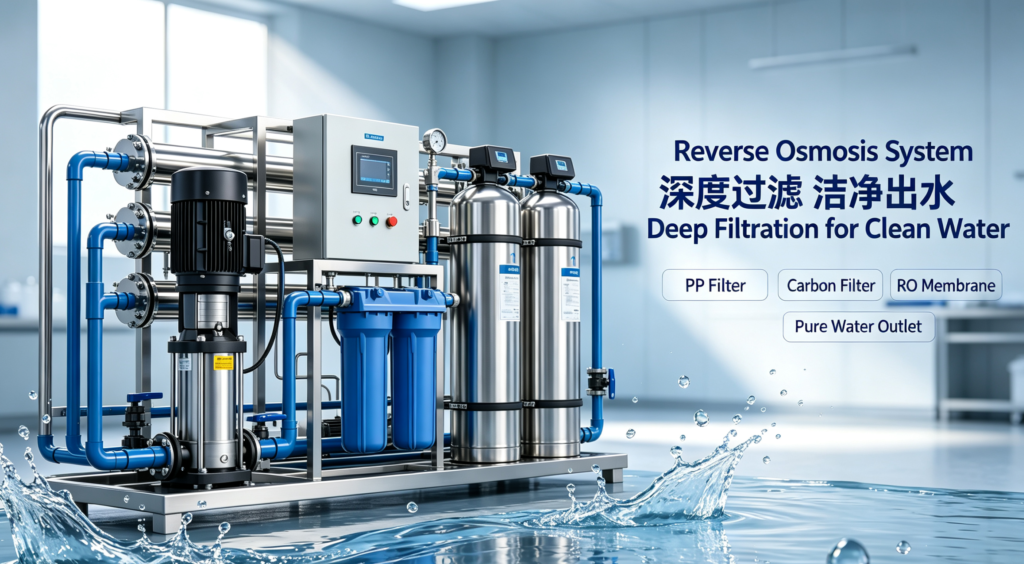
In the expansive and demanding world of heavy industry, manufacturing, and large-scale utilities, the need for immense volumes of consistently purified water is paramount. Contaminated or unsuitable water can lead to catastrophic equipment failure, compromised product quality, and severe operational inefficiencies. The Stark Water Large Industrial Reverse Osmosis Equipment is meticulously engineered to address these challenges head-on, providing a high-capacity, robust, and reliable solution for comprehensive water desalination purification.
This large industrial reverse osmosis equipment is built from the ground up for continuous, heavy-duty performance, capable of meeting the enormous water demands of major factories, power plants, and vast municipal systems. Its robust design, utilizing high-grade materials and industrial-strength components, ensures exceptional durability and longevity, even under the most challenging operating conditions. This scale allows for efficient throughput, minimizing downtime and maximizing productivity across extensive industrial processes.

Industriell Reverse Osmosis Equipment is a transformative solution for vast industrial and municipal water demands, capable of purifying immense quantities of diverse and challenging water sources, including seawater. Its immense capacity and robust design make it indispensable for:
- Municipal Water Utilities: Provides immense volumes of safe, potable drinking water for large towns, cities, or regional communities, especially vital in areas facing severe freshwater scarcity through large-scale desalination projects.
- Major Industrial Parks & Heavy Manufacturing Facilities: Supplies critical high-purity process water for vast industrial complexes including electronics, automotive, chemicals, pharmaceuticals, and metals processing, ensuring product consistency, preventing equipment damage, and meeting stringent quality standards for high-volume production.
- Food & Beverage Production Plants: Essential for producing massive quantities of purified water for global beverage brands (e.g., large-scale bottled water, soft drinks, breweries, dairies), extensive food ingredient processing, and comprehensive cleaning-in-place (CIP) systems, guaranteeing product safety and quality at scale.
- Power Generation & Energy Sector: Critical for boiler feed water purification in large thermal, nuclear, and combined-cycle power plants, massive cooling tower make-up water, and turbine washing, preventing scaling, corrosion, and optimizing energy efficiency of very expensive, high-pressure equipment.
- Pharmaceutical & Biotechnology: Serves as the primary purification unit to generate vast volumes of Purified Water (PW) and pre-treat for Water for Injection (WFI) for drug manufacturing, large-scale bioreactors, and extensive sterile environments, ensuring adherence to the strictest global GMP standards.
- Desalination Plants (Core System): Functions as the core Umkehrosmoseanlage in large-scale seawater purification and brackish water desalination plants, transforming saline sources into fresh water for various end-uses.
- Chemical Water Treatment Plants (Central Purification): Serves as the central purification unit in vast chemical water treatment plants, supplying immense quantities of high-purity water for complex chemical formulations, industrial reactions, and significantly reducing the chemical load on subsequent treatment steps.
- Mining & Metals Industry: For large-volume process water, mineral extraction, and advanced treatment of challenging water streams within large-scale mining and metals processing operations.
- Wastewater Treatment & Reuse (Advanced Systems): Employed in multi-stage advanced wastewater treatment facilities to produce high-quality effluent suitable for industrial reuse, agricultural irrigation, or even indirect potable reuse, promoting water conservation.