












The conductivity problem of reverse osmosis equipment purified water equipment is a problem often encountered by many purified water equipment manufacturers. In response to this situation, STARK Water Treatment summarizes the causes and solutions of the 7 common conductivity exceeding the standard, so that you can quickly, simply and effectively solve such problems.
1. Water quality problem: Check whether the raw water quality has changed significantly;
Solution: If the conductivity of the produced water increases due to abnormal increase in the conductivity of the inlet water, the conductivity of the inlet water can be adjusted. After the conductivity of the inlet water falls, the conductivity of the produced water will return to normal.
2. Conductivity meter: Check whether the conductivity meter works normally;
Solution: If the value displayed on the meter is incorrect, replace the new conductivity meter.
3. Membrane component problem: Check whether the reverse osmosis membrane component is aged or oxidized by the oxidizing medium.
Solution: If the desalination rate decreases due to this reason, replace the reverse osmosis membrane component;
4. Reverse osmosis membrane fouling: The reverse osmosis membrane is fouled due to pollution.
Solution: Clean the reverse osmosis membrane. It is recommended to perform regular chemical cleaning according to the operating instructions.
5. Operational issues: Is there a momentary shutdown or improper operation?
Solution: This situation can easily cause reverse osmosis membrane back pressure, reverse osmosis membrane rupture, and cause the conductivity of the produced water to rise sharply after restart. Replace the reverse osmosis membrane
6. Sealing ring problem: The sealing ring head is broken, and the conductivity caused by the leakage of the sealing ring connecting the reverse osmosis membrane assembly rises sharply.
Solution: It is recommended to replace the sealing ring. The specific method is to detect the water quality of each membrane assembly and find out the leaking part to replace.
7. Dosing problem: When the equipment is turned on, the secondary conductivity rises and it is difficult to drop or the drop time is too long. This situation is generally common in two-stage reverse osmosis. There is generally a measure to add sodium hydroxide between the first and second stages to adjust the removal of carbon dioxide in the water. The amount of sodium hydroxide added is related to the conductivity. It is recommended to adjust the amount of addition.
If you want to purchase more water treatment equipment, please contact us
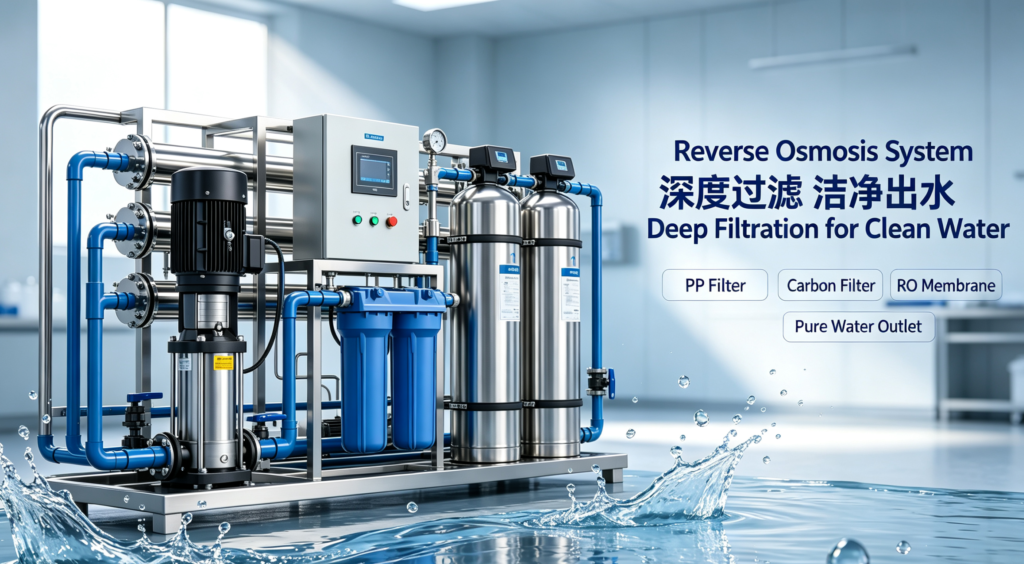
In the expansive and demanding world of heavy industry, manufacturing, and large-scale utilities, the need for immense volumes of consistently purified water is paramount. Contaminated or unsuitable water can lead to catastrophic equipment failure, compromised product quality, and severe operational inefficiencies. The Stark Water Large Industrial Reverse Osmosis Equipment is meticulously engineered to address these challenges head-on, providing a high-capacity, robust, and reliable solution for comprehensive water desalination purification.
This large industrial reverse osmosis equipment is built from the ground up for continuous, heavy-duty performance, capable of meeting the enormous water demands of major factories, power plants, and vast municipal systems. Its robust design, utilizing high-grade materials and industrial-strength components, ensures exceptional durability and longevity, even under the most challenging operating conditions. This scale allows for efficient throughput, minimizing downtime and maximizing productivity across extensive industrial processes.

Industrial Ósmosis inversa Equipment is a transformative solution for vast industrial and municipal water demands, capable of purifying immense quantities of diverse and challenging water sources, including seawater. Its immense capacity and robust design make it indispensable for:
- Servicios municipales de agua: Proporciona enormes volúmenes de agua potable segura para grandes pueblos, ciudades o comunidades regionales, especialmente vital en zonas que se enfrentan a una grave escasez de agua dulce mediante proyectos de desalinización a gran escala.
- Grandes parques industriales e instalaciones de fabricación pesada: Suministra agua de proceso de gran pureza a grandes complejos industriales como los de electrónica, automoción, química, farmacia y procesamiento de metales, garantizando la consistencia del producto, evitando daños en los equipos y cumpliendo las estrictas normas de calidad para la producción de grandes volúmenes.
- Plantas de producción de alimentos y bebidas: Esencial para producir cantidades masivas de agua purificada para marcas de bebidas globales (por ejemplo, agua embotellada a gran escala, refrescos, cervecerías, lecherías), procesamiento extensivo de ingredientes alimentarios y sistemas integrales de limpieza in situ (CIP), garantizando la seguridad y calidad del producto a escala.
- Generación de energía y sector energético: Crítico para la purificación del agua de alimentación de calderas en grandes centrales térmicas, nucleares y de ciclo combinado, agua de reposición masiva de torres de refrigeración y lavado de turbinas, evitando la formación de incrustaciones, la corrosión y optimizando la eficiencia energética de equipos muy caros y de alta presión.
- Farmacéutica y biotecnología: Sirve como unidad de purificación primaria para generar grandes volúmenes de Agua Purificada (PW) y pretratamiento para Agua para Inyección (WFI) para la fabricación de fármacos, biorreactores a gran escala y amplios entornos estériles, garantizando el cumplimiento de las normas GMP globales más estrictas.
- Desalination Plants (Core System): Functions as the core sistema de ósmosis inversa in large-scale seawater purification and brackish water desalination plants, transforming saline sources into fresh water for various end-uses.
- Plantas de tratamiento químico del agua (depuración central): Sirve como unidad central de purificación en vastas plantas de tratamiento de aguas químicas, suministrando inmensas cantidades de agua de alta pureza para formulaciones químicas complejas, reacciones industriales y reduciendo significativamente la carga química en los pasos de tratamiento posteriores.
- Industria minera y metalúrgica: Para aguas de proceso de gran volumen, extracción de minerales y tratamiento avanzado de flujos de agua difíciles en operaciones de procesamiento de metales y minería a gran escala.
- Tratamiento y reutilización de aguas residuales (sistemas avanzados): Empleados en instalaciones avanzadas de tratamiento de aguas residuales en varias etapas para producir efluentes de alta calidad aptos para la reutilización industrial, el riego agrícola o incluso la reutilización potable indirecta, fomentando la conservación del agua.